Free IELTS Writing, Reading & Listening Test — plus Free Lessons
Sit a full mock test with real examiner-standard marking — no signup needed to try your first.
Why I built English Me.
I teach IELTS in Southern Vietnam, and I built English Me in order to help students access reliable writing and speaking assessments that are powered by AI. I also provide lessons online via interactive webpages and YouTube.
The Virtual Examiner I built for English Me marks your work the way an examiner does: against the official band descriptors, one criterion at a time. Reading and Listening are checked against the real answer key. Writing and Speaking go to the Virtual Examiner — an AI marker I built and then tested against IELTS's own officially-marked scripts.
The Virtual Examiner
A short walkthrough of how the Virtual Examiner works, and why we built it this way.
How accurate is the Virtual Examiner, really?
Two of the four papers have a right answer, so we score them with a deterministic checker, not an AI guess. The other two need real judgement, so we fine-tuned an AI Virtual Examiner against officially-marked scripts — and measured it honestly rather than rounding up.
How close are we to the published score?
Every dot below is one real script or clip we've evaluated, plotted at what we actually report to the student — the raw score below band 7, or the midpoint of the range once it reaches band 7. Not an average, not a cherry-pick. The diagonal is a perfect match with the official, certified band; the shaded strip is our one-band tolerance.
Five points cross band 7, where we report a range instead of a single number — each is plotted at that range's midpoint, since that's what the student is actually graded on. The one clear outlier that remains — an official 7.5 Speaking clip scored 6.0 every time, by every version we tried — never reached band 7, so no range applied. It's the single hardest case in the whole set, discussed honestly in the callout below rather than left off the chart.
Why not aim for 100%?
Writing and Speaking aren't answer-key tasks. Marking them means weighing vocabulary against grammar against how well an argument holds together — real judgement calls, not a lookup. A tolerance of one band is us reporting that honestly rather than rounding a score up to look more precise than the marking actually is.
Figures are internal evaluations, not a certified result. Sample sizes are still small (5 Writing scripts, 12 Speaking clips) — we're growing the evaluation set as more officially-marked material becomes available.
Built and evaluated against IELTS's own published materials: the official 2023 Academic Writing sample tasks (officially-marked scripts and examiner comments) for Writing; certified score-band clips from ielts.org's score-setting resource and the IELTS Official YouTube channel for Speaking; and the official 2023 Listening and Reading sample tasks and answer keys for the deterministic engine. IELTS is a registered trademark of the British Council, IDP: IELTS Australia and Cambridge Assessment English — English Me is an independent study platform and is not affiliated with or endorsed by IELTS or its owners.
Get the band you need — no guessing.
Full mock tests, marking that mirrors the real band descriptors, and feedback from people who've examined the actual exam. Know your score before test day — then close the gap.
Master each paper on its own terms
Catch every answer
Section-by-section drills, accent training and the note-taking system that stops you losing easy marks.
Beat the clock
Skimming, scanning and question-type tactics so you finish all 40 with time to check.
Structure that scores
Task 1 and Task 2 templates, model answers, and feedback on the exact descriptors examiners use.
Fluency under pressure
The Part 2 long turn, recorded in your browser and graded on fluency, range, grammar and pronunciation.
What band do you actually need?
Your target band decides how you prepare. These are the typical minimums for study and for visas — set your goal, then close the gap.
Typical minimums only — requirements change often and vary by institution, program, visa stream and processing year. Always confirm the exact score on the official university or government website before you book your test. Visa/immigration routes often require the IELTS for UKVI or a specific test version.
A clear path from today's band to your target
- ✓ Sit a real paper — timed practice papers in the same layout as the exam. Live now for Writing, Reading and Speaking.
- ✓ Marked against the descriptors — a band for every criterion, with the reasons behind it, not a single number. Live now.
- ✓ Free Writing lessons — structured Task 1 and Task 2 lessons that teach the language the marking rewards. Three lessons live, more coming.
- ✓ Track your bands over time — see each skill move as you practise. Not built yet.
The full diagnostic-to-target journey described here (a four-skill mock, a plan generated from your test date, weekly progress tracking) is the roadmap, not the current build. This block should stay honest about which parts are live until those exist.
Why marked practice beats more practice
Writing another essay nobody marks teaches you very little. Writing one that comes back with a band for each criterion — and the reason it landed there — shows you which of the four things you're actually losing marks on, and what to fix first.
Understand why, not just what, you're losing marks on.



Trial images — AI-generated placeholders, not real students.
Start closing the gap this week.
Work through this week's Writing lesson, get the language and structure IELTS examiners are marking for, then write the paper it's built from.
Two tasks, 60 minutes, no wasted words.
Task 1 tests whether you can describe data accurately and concisely. Task 2 tests whether you can build an argument. Here's exactly what's being marked, before you sit down to write.

What you're actually sitting
Describe, don't invent
You're given a chart, graph, table, process diagram or map and about 20 minutes to summarise it accurately in your own words — no opinions, no outside knowledge, just what's actually shown.
Argue a position
An essay question — usually a viewpoint, argument or problem — with about 40 minutes to respond directly to every part of the prompt with a clear position and supporting reasons.
What examiners are marking
- ✓ Task Achievement / Response — did you actually answer what was asked?
- ✓ Coherence & Cohesion — does it flow, organised into clear paragraphs?
- ✓ Lexical Resource — range and accuracy of vocabulary.
- ✓ Grammatical Range & Accuracy — variety and correctness of sentence structures.
Five things that move a Writing band
None of these are tricks. They're the mistakes that cost marks most often, in the order they tend to cost them.
Do Task 2 first
It's worth twice as much as Task 1, and it's the one people run out of time on. Give it the 40 minutes it deserves, then spend the remaining 20 on Task 1.
Answer the actual question
Task Response is a full quarter of your band. A brilliant essay that answers a slightly different question — or only half of a two-part prompt — is capped before the examiner reads a single sentence for grammar.
Give Task 1 an overview
A Task 1 answer with no overview paragraph cannot reach the top bands, however accurate the detail is. Write the trends in their own paragraph, straight after the introduction, before any numbers.
Plan for five minutes
Deciding your position and your two body paragraphs before you write costs five minutes and buys back far more — most Coherence marks are lost in essays that were composed live.
Don't memorise an essay
Pre-learned paragraphs are obvious to an examiner and are penalised under Task Response — and they rarely fit the question you actually get. Learn structures and language you can adapt, not scripts. The same goes for stuffing in "advanced" vocabulary you're not sure of: Lexical Resource rewards precision, and a misused rare word scores worse than a well-used common one.

Drafting by hand, exam conditions — AI-generated illustration, not a real student.
How your Writing gets marked here
Your script is marked by the Virtual Examiner against the same four criteria above, each judged on its own rather than blurred into a single overall impression. You get a band for each criterion and the reasons behind it — not just a number.
On our evaluation set it lands within one band of the official mark on 80% of officially-marked Task 2 scripts. Where a script reaches the top of the scale we report a range rather than a single figure, because that's the honest width of the judgement at that level.
Try a real Writing Task 1 paper
Free to write, no account needed. Band-scored AI feedback against the real examiner criteria requires a free English Me account — launching soon.
Three passages, 40 questions, one hour.
Reading has a right answer for every question, so it's the one skill where "am I correct" isn't a judgement call. Here's the format before you sit the real thing.

What you're actually sitting
General, easier
Everyday or general-interest topic — the easiest passage, meant to build early confidence and momentum.
Work-related
Often tied to workplace or training contexts, with moderately more demanding vocabulary and question types.
Academic, hardest
A longer, more complex academic text with abstract ideas — where most of the time pressure really bites.
How it's marked
Every question has one correct answer, checked against IELTS's own published answer key. There's no examiner judgement involved — just whether you found the right information under time pressure.
Five things that move a Reading band
Reading is the paper where technique closes the gap fastest, because the answers are all right there on the page. The problem is the clock.
Read the questions first
Don't read the passage through before you start — you don't have the twenty minutes that costs. Skim for structure, then go to the questions and read closely only where you need to.
Answers run in order
Within most question sets, the answers appear in the same order as the text. If you've found number 6, number 7 is below it — don't go back to the top and start again.
"Not Given" isn't "False"
False means the passage contradicts the statement. Not Given means the passage simply doesn't address it. Deciding from your own knowledge instead of the text is the single most common way marks are lost here.
Obey the word limit
"NO MORE THAN TWO WORDS" is a rule, not a suggestion — three words scores zero even when the meaning is perfect. Copy the spelling from the passage exactly.
Never leave a blank
There's no penalty for a wrong answer in IELTS Reading, so an unanswered question is a guaranteed nothing where a guess is a chance. Watch the clock on Passage 3 especially — if you're running out of time, fill every remaining box before the hour ends. And remember there's no extra transfer time in Reading as there is in Listening: write answers straight onto the answer sheet as you go.

Reading closely against the clock — AI-generated illustration, not a real student.
Try a Reading practice paper
This is one 13-question passage, not a full 40-question paper, so it's marked against the answer key but no band score is estimated. Free to attempt, no account needed. Full three-passage papers are in development.
Four sections, 40 questions, played once.
You hear each recording exactly once, so Listening rewards preparation as much as raw ability — knowing what's coming next matters. Here's the format before test day.

What you're actually sitting
Everyday conversation
Two people talking in a social context — like booking accommodation or asking about a course.
Everyday monologue
One speaker giving information in an everyday context, such as a talk about local facilities.
Academic conversation
Up to four people discussing an academic or training topic, like students planning an assignment.
Academic lecture
A monologue on an academic subject, close to a university lecture — the hardest section.
How it's marked
Every question is checked against IELTS's own published answer key. There's no examiner judgement — the challenge is catching the right information as it goes past, once.
Five things that move a Listening band
You only hear it once, so almost everything that helps happens before the recording starts.
Use every pause to read ahead
The gaps before each section exist so you can read the upcoming questions. Spend them there, not checking answers you've already written — going in cold is what makes the recording feel fast.
Predict what kind of answer fits
Before you hear it, decide whether the gap needs a number, a date, a name or a noun. Knowing you're waiting for a price makes it far harder to miss when it arrives.
Expect the speaker to change their mind
"It's on Tuesday — sorry, no, Thursday." Corrections like this are deliberate, and they're everywhere. The answer is almost always the second thing said, not the first.
Spelling and grammar count
A misspelled word is marked wrong even if you clearly heard it. So is a plural where the sentence needs a singular. Names and places get spelled out aloud — write them down letter by letter.
If you miss one, let it go
The most expensive mistake in Listening isn't missing an answer — it's still thinking about it while the next three go past. Put a mark next to it, move on, and come back during transfer time. On the paper test you get ten extra minutes at the end to copy your answers across; on the computer test you get two, so write straight into the boxes as you go.

Note-taking under time pressure — AI-generated illustration, not a real student.
Try a Listening practice paper
This is a complete four-section, 40-question paper with real recordings played once, marked instantly against the answer key with an approximate band. Free to attempt, no account needed.
One cue card, two minutes, no interruptions.
English Me's Speaking test is Part 2 only — the long turn. One cue card, one minute to prepare, two minutes to speak. It's the one part of the exam we can reproduce exactly, so it's the part we do.

What you'll actually do here
This is the Part 2 long turn on its own — three minutes end to end, in your browser. There's no interview and no discussion round.
The full exam has three parts
On test day you'll sit 11–14 minutes with one examiner, covering all three parts below. Only the middle one is what you practise here — Parts 1 and 3 are listed so you know what else is coming.
Introduction & interview
4–5 minutes of general questions about yourself — home, work, study, familiar everyday topics — to settle you in before the harder parts.
Not yet in our practice test.
The long turn
You get a cue card, one minute to prepare notes, then speak for up to two minutes on that topic without interruption.
This is what English Me practices & marks.
Two-way discussion
4–5 minutes of more abstract questions that build on the Part 2 topic — you're pushed to explain and justify opinions, not just describe.
Not yet in our practice test.
What examiners are marking
- ✓ Fluency & Coherence — how naturally you speak and connect ideas, hesitation included.
- ✓ Lexical Resource — range and precision of vocabulary, including idiomatic language.
- ✓ Grammatical Range & Accuracy — variety and correctness of grammar under time pressure.
- ✓ Pronunciation — clarity, stress and intonation — being understood, not sounding like a native speaker.
Five things that move a Speaking band
Speaking rewards the student who keeps going. Most of what costs marks here is hesitation and under-answering, not grammar.
Use the whole minute, and the whole two
In Part 2 you get a minute to make notes — use it, and write key words rather than sentences. Then keep going until the examiner stops you. Finishing at fifty seconds costs you marks you'll never get back.
Always extend
Never answer just the question. Add a reason, an example, or a contrast — "because…", "for instance…", "although…". A two-word answer gives the examiner nothing to award a band for.
Clarity beats accent
Pronunciation is marked on whether you're easy to understand — stress, rhythm and clear sounds. You are not being marked on sounding British or American, and trying to is a distraction.
Keep talking through mistakes
Fluency counts hesitation and self-correction. Noticing an error and fixing it briefly is fine; stopping dead and restarting the sentence three times is what actually costs you.
You don't have to tell the truth
The examiner is marking your English, not fact-checking your life. If the cue card asks about a holiday you've never taken, invent one — a fluent invented answer scores far better than an honest, halting one. What you must not do is deliver a memorised speech: examiners are trained to spot it, and it's penalised.
Why we practise Part 2 only
Parts 1 and 3 are conversations. Reproducing them honestly means an examiner who listens to your answer and asks a real follow-up — twelve minutes of back-and-forth, marked live. That's a much harder thing to build than a cue card, and a far more expensive one to run for every student who wants a practice go.
Part 2 is a monologue. You get a card, you speak for two minutes, nobody interrupts — which means a recording of your Part 2 is genuinely the same task you'd sit in the exam, not an approximation of it. It's also where the four criteria show up most clearly, because you're sustaining language on your own rather than being carried by the examiner's questions.
So we do the part we can do properly, and we say so rather than implying you've had a full mock exam. Parts 1 and 3 are on the roadmap, not pretended.

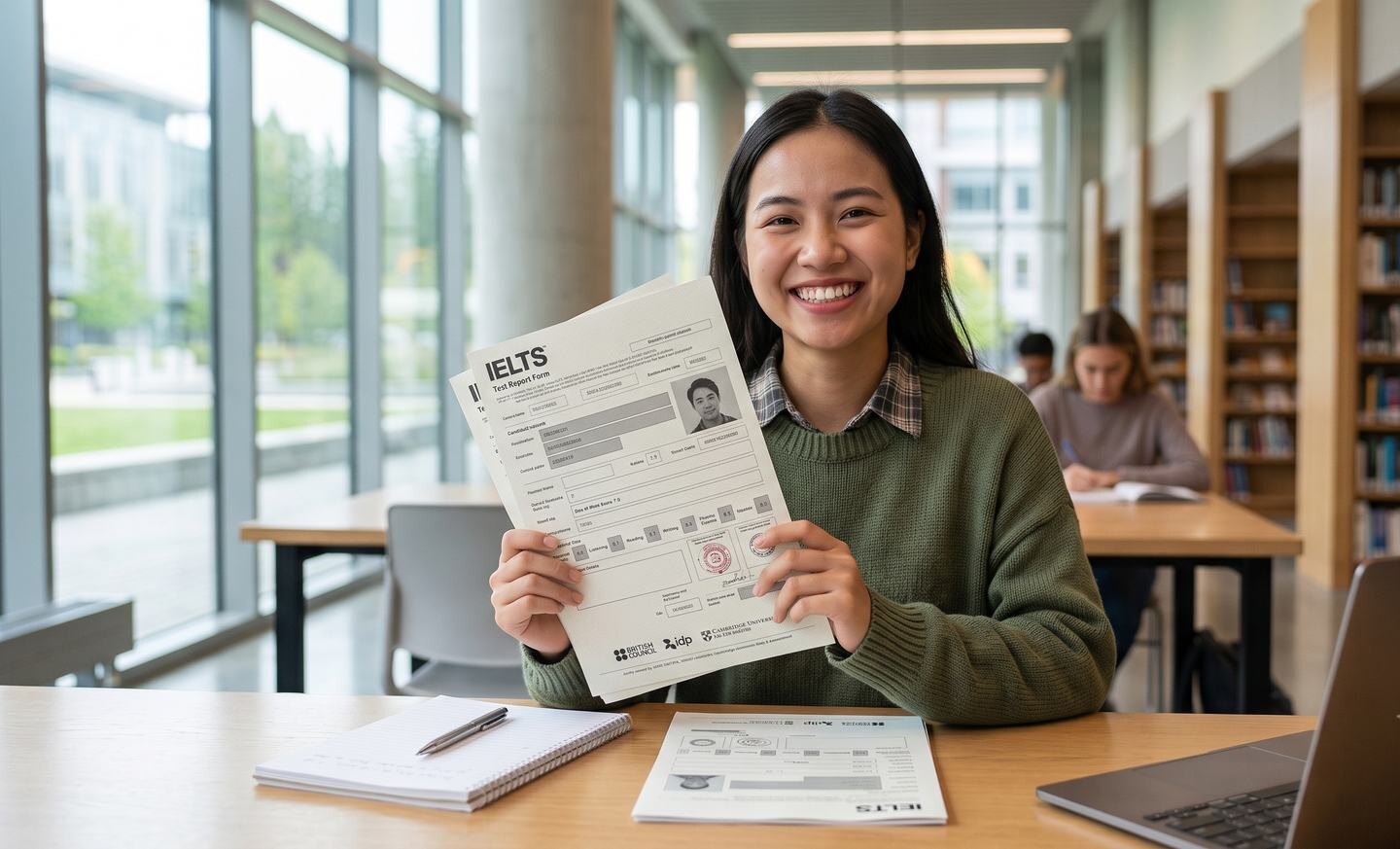
Certificate day — AI-generated illustration, not a real student.
Try a Speaking practice paper
Free to attempt as many times as you like, no account needed — recordings stay on your device. Band-scored AI feedback on a recording costs 20 credits and needs an English Me account. Unlike Reading, Listening and Writing, Speaking has no free marked test — marking a two-minute recording is the most expensive thing we do.
Free IELTS lessons.
Every lesson comes two ways — do it on screen, or print it out and work on paper. The printable version carries the same exercises with the answer key upside down at the bottom. Both are free, with no login and no credits.
The teacher behind English Me.
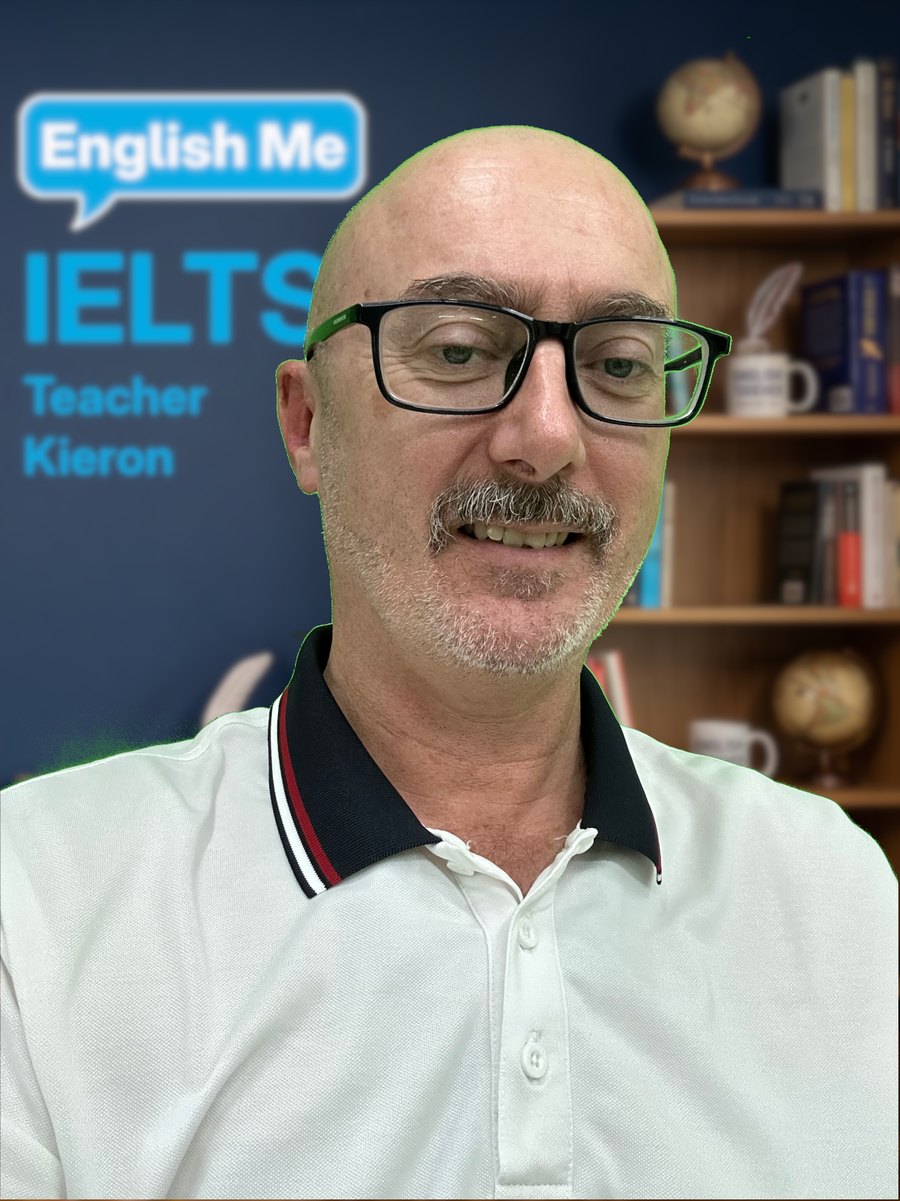
English Me is built and taught by one person, not a content farm. Everything on this site — the lessons, the practice papers, the marking standard the Virtual Examiner was built against — comes out of real IELTS classrooms in Ho Chi Minh City.
Taught the exam. Then built the marker.
The Virtual Examiner isn't a general-purpose chatbot asked to guess a band. It was built by someone who marks to the official descriptors, then measured against IELTS's own published scripts until the numbers held up.
I teach English and STEM in Vietnam. I started out in high schools in London in 2005, and I've been teaching in South East Asia since 2014 — IELTS and other English language courses, in both schools and language centres. I currently also teach Cambridge IGCSE 0500 First Language English.
The STEM side is an unusual pairing for an English teacher, and it's exactly that combination that let me build English Me. This website is my own work: I designed and built the site you're reading, and the Virtual Examiner that marks your Writing and Speaking.
I hope what you find here is genuinely useful for your English studies.
A marking standard, not an opinion
Most AI feedback tools will happily award you a band. Very few will tell you how often that band matches the one a real examiner gave the same script — because most have never checked.
Feedback is only worth having if someone checked it against the real thing.
Daily IELTS tips, on your feed
Short lessons, band-score breakdowns and exam-day advice — posted where students already are.
This block will become a live social feed once the accounts are confirmed. It needs two things that don't exist yet: the account handles/URLs, and a decision on how to embed them.
Note that embedded TikTok and Facebook feeds load third-party scripts, which conflicts with the strict content-security policy the rest of this site runs under — so the likely answer is a periodically-refreshed grid of post links rather than a native embed. Worth settling before this page goes public.

Students leaving school in Ho Chi Minh City — AI-generated illustration, not a real student.
Privacy Policy
Last updated: August 6, 2026. This page covers the English Me website, member accounts, practice tests and automated marking at englishme-ielts.com. Plain language first, details below.
We keep your scores, not your scripts.
- ✓You can read the site and browse practice papers without an account. Marking, saved results and your certificate need one — an email address and a password.
- ✓Your password is stored only as a salted PBKDF2-SHA256 hash. We cannot read it, and nobody here can tell you what it is.
- ✓Essays and speaking recordings are sent to our AI marking provider to be marked, then discarded. We keep the band scores, not the script or the audio.
- ✓The photograph on your certificate is optional, is stored with your account, and you can replace or remove it yourself at any time.
- ✓We never see your card number or your banking login. Payments are handled entirely by the payment provider you choose.
- ✓No advertising trackers, no cross-site analytics, nothing sold to anyone. Ever.
What we hold, and why
Your account
When you register we store your email address, the name you give us, a salted PBKDF2-SHA256 hash of your password, and the date you joined. The email address is how we identify your account, send password-reset links, and match a payment to the right person. Signing in returns a signed session token that your browser keeps in its own local storage for up to 30 days; it is not an advertising cookie and it is not shared with anyone.
Your certificate details and photograph
The practice Test Report Form can show a first and family name, date of birth, sex, country of nationality, first language, test date, and a photograph. All of it is optional and all of it is typed in by you — we never collect it from anywhere else. It exists for one purpose: to make your practice certificate look like the real thing so the exam holds no surprises.
If you add a photograph, your browser shrinks it before it ever leaves your device and it is stored with your account record, not in any public location or shared image library. It is shown only to you, when you are signed in. Click the photograph on your certificate at any time to replace it, or to remove it entirely — removing it deletes it from our storage, it is not merely hidden.
Your results
For each practice paper you complete we store the skill, the band score or raw score, the date, and whether the mark came from the automated marker or from you. That's the whole record. Your overall band is calculated from these, never stored as a separate judgement about you.
What we deliberately don't keep
Your Writing scripts and Speaking recordings pass through our Worker to the AI marking service and are not written to our storage at any point. Once the marker returns the bands, the essay and the audio are gone from our side. One deliberate exception: answers you submit from a lesson page are saved together with your email address, so your teacher can read them and give feedback — that is the entire point of the exercise, and those answers are kept until you ask us to delete them.
Payments and credits
We store your credit balance and a record of each order: an order code, the pack bought, the amount, the status and the date, tied to your email address. Bank transfers are matched using the reference shown on the payment screen. We never receive, and could not store, your card number, CVV, or banking password — those go directly to the payment provider. We are also notified by a private message when an order is placed, which includes your email address and the amount so we can confirm the payment manually.
What we don't collect at all
No advertising identifiers, no third-party analytics, no cross-site tracking, no browsing history, no contact list, no location. This site runs no analytics or ad scripts of any kind. We do not use your work to train AI models.
Third-party services we use
Cloudflare
Hosts the site and runs the Worker and storage behind your account. Your account record, results and certificate details live on Cloudflare's infrastructure, under its own privacy policy.
OpenRouter
Routes your essay or recording to the AI model that marks it, under its own privacy policy at openrouter.ai. We don't control what OpenRouter or the model provider retains — check their policy for their side of it.
PayPal
Handles card and PayPal payments. Its script runs on the members page and it receives your payment details directly; we receive only the confirmation that an order was paid.
NOWPayments
Handles cryptocurrency payments and tells us when one clears. It receives the order code and amount, under its own privacy policy at nowpayments.io.
VietQR
Renders the QR image for a Vietnamese bank transfer from our account number, the amount and your order reference. It does not receive your name or your account details.
Telegram
Delivers the private order alert described above — order code, amount and your email address — to us, so a manual bank transfer can be confirmed quickly.
Keeping it, and getting rid of it
Your account and its results are kept while the account exists, because a progress record you lose every term is no use to anyone. You can edit or clear your certificate details and photograph yourself, whenever you like, from the members page. To have the whole account deleted — results, photograph, lesson answers and order history — email us and we will remove it. You do not have to give a reason.
Your rights
You can ask us what we hold about you, ask for a copy of it, ask us to correct it, or ask us to delete it. Email the address below and we'll deal with it. Most of it you can already see and change yourself on the members page — that is deliberate.
Children's privacy
English Me is intended for candidates preparing for IELTS and is not directed at young children. If a student under 16 uses the site, a parent or teacher should set up and oversee the account.
Changes to this policy
If this policy changes we'll update the "Last updated" date at the top of this page, and meaningful changes to how your data is handled will appear here before they take effect.
Contact us
Privacy questions, data requests, account deletion — email support@englishme-ielts.com.